Journal
Building licensed operations
State-licensed cannabis work in Washington, from 2014 to 2024.
Chronology
2014 to 2015
The first licensed site. In 2014, while I was still working in engineering, I funded the conversion of a family country house and workshop into a state-approved cannabis producer and processor. The site had three 2,700 square foot greenhouses.
In 2015 the facility was rented to businesses that needed an approved location.
Fall 2016
A move to Washington, and a first harvest. In the fall of 2016 I moved to Washington. That season’s outdoor harvest was about 300 pounds dry, and more.
2017
Two Tier 3 outdoor licenses. In 2017 I built two Tier 3 outdoor licenses, approved by the state, on very little capital. I managed about a dozen independent grow teams as subcontractors under those licenses.
2018 to 2020
The greenhouse, and more licenses. From 2018 to 2020 I took over the greenhouse operation after a tenant failed. I built supplemental lighting and light-deprivation upgrades myself. I also built additional outdoor grows and license-holding sites, sourcing licenses and selling them, a process that took three to six months.
Brands, wholesale, and services. I partnered with the Tommy Chong brand, selling to retail stores, and developed my own brands, which were carried in many Washington retail stores. The work included wholesale, managing growers and processors, and in-house packaging. I also provided harvest services for other grows for a share, and produced and sold clones.
I helped two outdoor operations plant, harvest, and reach store shelves. I built automated drip irrigation, and installed state-approved security systems as a paid side business.
2021 to 2024
An indoor grow from a bare plot. From 2021 to 2024 I sold a license and property to fund a new build: a first all-indoor grow on a bare plot. A well was installed. I worked with the utility district on a larger transformer, doing the work myself with an electrician’s advice. With carpenters, I built a 50 by 100 foot fabric building, framed grow rooms, and used torch-down flooring to keep cost down.
I wired two 60-light rooms at maximum service capacity, using a Gavita controller to alternate the rooms, and installed an automated Netafim system that fed both rooms. The facility was licensed.
Running the rooms. I ran a rigid two-week crop rotation, with cloning, transplant, harvest, and dry timed so that nothing backed up, and managed pests. The operation started lean, with three people, and grew with a partner and helpers.
While overseeing the indoor rooms I also ran an outdoor grow with another Netafim system, for a harvest of about 1,000 pounds dry weight. The business was wholesale-focused. I later sold the grow building. Its low-cost rural-rent model was widely copied in the region.
A barn, licensed and sold. I then rebuilt an old two-floor barn: I removed moldy walls and bad wiring, reframed the structure, and installed security. The barn was licensed, and I sold the license with a lease.
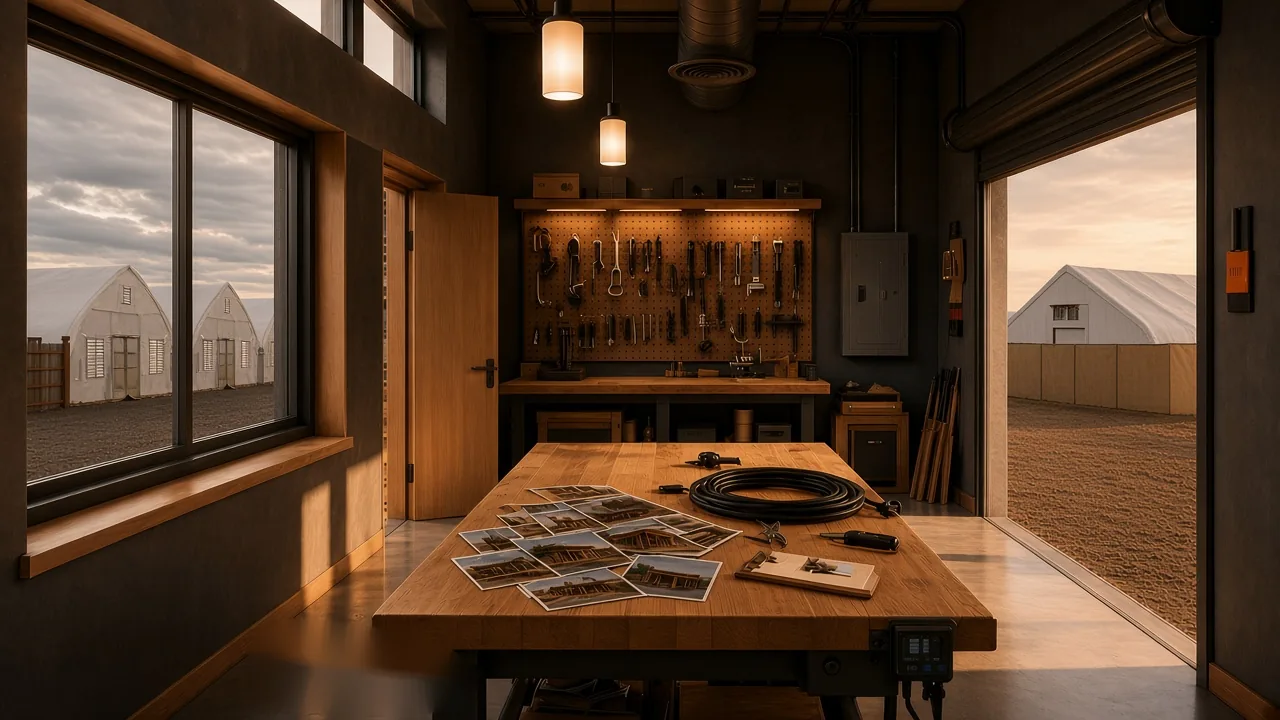
The hoop greenhouses in the left window open photographs from McCleary. The fabric building through the open bay door opens a construction-progression gallery from Oso, in order from phase 1 to phase 11. The pile of photographs on the bench opens farming photographs. The pegboard on the back wall opens before-and-after photographs from Stanwood. The grey electrical panel, to the right of the pegboard, opens photographs of electrical work and security cameras.